
Surprising stat to start: a wallet that simulates transactions before you sign them can reduce “blind signing” risk more effectively than any single UI nudge. For DeFi power users — traders, liquidity providers, and yield farmers operating across EVM chains — that single design decision changes how you reason about operational risk. Rabby Wallet builds transaction simulation and proactive risk scanning into daily workflows, and that changes the security calculus in meaningful ways. But simulation is not a panacea; understanding its assumptions and boundaries is crucial to using it well.
This piece compares Rabby to mainstream alternatives, explains the mechanisms behind its key protections, and gives a practical framework for when you should pick Rabby — and where you still need additional safeguards. The goal is decision-useful: leave knowing the precise threat vectors Rabby addresses, the ones it doesn’t, and the operational habits that materially reduce exposure when interacting with DeFi in the United States.
How Rabby changes the signing decision: mechanism, not magic
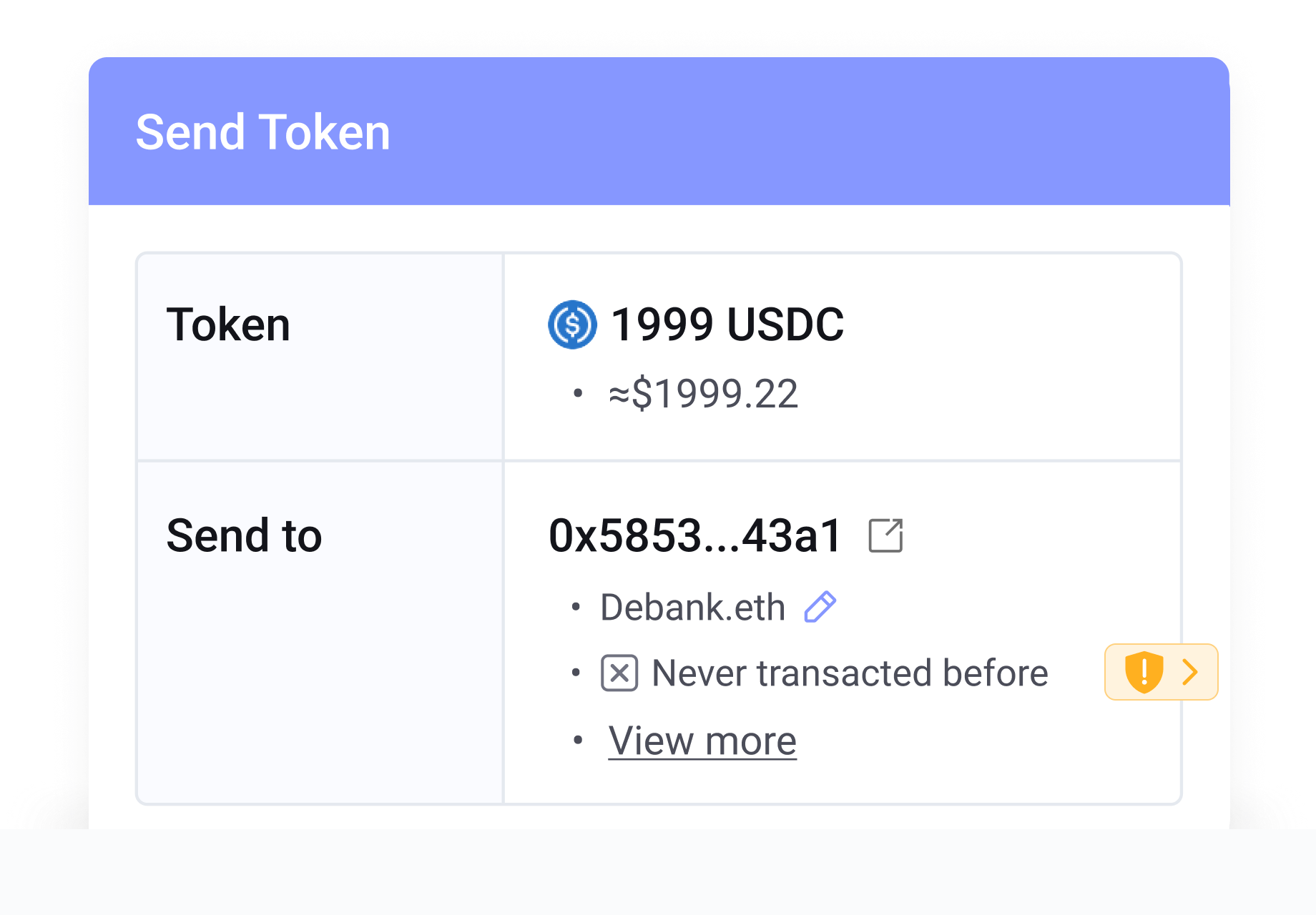
Most browser wallets present a signing dialog that lists the raw transaction call data and an approximate gas fee. That forces users to interpret low-level details or trust a dApp. Rabby inserts a simulation layer before the signing step. Mechanically, when you initiate a transaction the wallet replays the intended transaction against a node or a local EVM simulation to produce an explicit summary: estimated token balance deltas, contract calls, and an itemized fee estimate. It then runs those results through a security engine that checks for known malicious indicators — hacked contracts, suspicious approval amounts, and atypical recipient addresses.
Why the mechanism matters: simulation replaces a cognitive burden (interpreting calldata) with a concrete outcome (what your balances will be after the transaction). That shifts user decisions from pattern-matching raw hex to evaluating a human-readable impact. For many DeFi users this is the difference between shrugging and detecting a red flag.
Limitations you must know: simulations depend on accurate state snapshots and the particular node used for replay. Front-running, mempool manipulation, oracle-dependent logic, or time-sensitive contract behavior can create gaps between simulated and executed outcomes. In short, simulation reduces information asymmetry but cannot guarantee outcomes that depend on off-chain events or adversarial actors reacting in the mempool.
Side-by-side: Rabby versus MetaMask and Coinbase Wallet — security trade-offs
For DeFi power users the choice of wallet often balances convenience, ecosystem compatibility, and attack surface. Below is a practical comparison focused on security and workflow features relevant in the US context.
Rabby’s distinctive protections
– Transaction simulation and pre-transaction risk scanning: provides a deterministic, human-readable summary of expected balance changes and flags risky patterns.
– Automatic network switching: less friction when moving among dApps across chains; reduces mistakes caused by operating on the wrong chain (a common source of failed or dangerous transactions).
– Approval revocation tool: lets users view and cancel token approvals from within the wallet, reducing the long tail of exposure that stale approvals create.
– Extensive hardware wallet integration and institutional connectors (Gnosis Safe, Fireblocks): supports more advanced custody setups and multisig workflows.
What mainstream alternatives typically offer
– MetaMask: broad ecosystem compatibility, user familiarity, and many third-party monitoring tools, but lacks built-in transaction simulation as a core feature; users often rely on external services for risk checks.
– Coinbase Wallet / Trust Wallet: integrated fiat on-ramps and simpler onboarding for retail users, but less emphasis on granular pre-signing simulation and approval management.
Resulting trade-offs
– If your priority is defensive clarity on every on-chain interaction, Rabby’s simulation and revocation tools give higher immediate signal quality. That is especially important when moving large sums or interacting with composable protocols where approvals can cascade risk.
– If you need in-wallet fiat buys or seamless retail rails in the US, Rabby currently lacks a built-in fiat on-ramp — you’ll need a secondary custody or exchange step. Likewise, Rabby doesn’t provide native staking dashboards for some chains, so staking-heavy users will want additional tooling.
Operational discipline: how to combine Rabby with other controls
Security is layered. Rabby handles a particular layer — pre-signature decisioning — exceptionally well. But power users should combine it with at least three other controls:
1) Hardware wallet for custody: Rabby supports Ledger, Trezor, Keystone and others, and integrating a hardware key reduces private-key theft risk. Use Rabby’s extension purely as an interface and keep signing on the device.
2) Multisig for treasury or large holdings: for institutional-sized funds or shared treasuries, Rabby’s integrations with Gnosis Safe and custody vendors allow you to keep high-value operations behind multi-approval gates.
3) Approval hygiene and periodic clean-ups: use Rabby’s revocation tool regularly. Token approvals granted to DEXs and protocols are one of the most common vectors for siphons; seeing the exact invited allowances and canceling them when idle materially reduces exposure.
These are practical additions, not optional niceties: a hardware wallet prevents browser-level key extraction, multisig prevents a single-phish compromise from draining treasury, and approval hygiene shrinks the blast radius of any rogue contract call.
Where Rabby still needs help — honest boundary conditions
Be explicit about what Rabby cannot do. It is open-source under MIT, so independent audits are possible — but open-source does not equal audited or bug-free. In 2022 Rabby Swap had an exploited smart contract that cost roughly $190,000; the team froze the contract and compensated users, but the incident is a reminder that integrated swaps, even in wallets, increase attack surface. Audits and rapid response helped; prevention is never absolute.
Other concrete limits: Rabby lacks a native fiat on-ramp and does not include built-in staking functionality. For US users who need USD-to-crypto rails, that means having a trusted exchange or on-ramp service outside the wallet. For validators and yield operators who want in-wallet staking controls, Rabby’s current model requires external staking services or dashboards.
Finally, simulations can lull users into overconfidence. They are highly useful for detecting blatant anomalies — oversized approvals, hacked contract signatures, impossible balance changes — but nuanced attack strategies that leverage oracle manipulation or conditional logic triggered by block timing can still slip through. Treat simulation as informative evidence, not proof of safety.
Decision framework: when Rabby is the right tool
If you recognize your workflow in any of the following, Rabby is likely a strong fit:
– You regularly interact with composable DeFi on multiple EVM chains and need fast, low-friction network switching.
– You require clear pre-signature visibility because you manage funds for teams, research, or a fund and want a defensible internal review step before signing transactions.
– You want built-in tools to reduce exposure from stale ERC-20 approvals and integrate hardware wallets or multisig custody into your daily UX.
When you might prefer a different stack
– You derive most value from in-wallet fiat purchases and prefer a consolidated retail experience; a Coinbase-linked product or exchange custody will be more convenient.
– You need native staking management within the wallet; Rabby requires complementary services for some chains.
Heuristic takeaway: prefer Rabby when your marginal value is improved pre-signing intelligence and approval control; prefer wallets with fiat rails when onboarding or quick retail buys are the priority.
What to watch next — conditional signals that would change the calculus
Three signals would materially shift Rabby’s relative advantage in the next 6–12 months (presented as conditional scenarios, not predictions):
– If Rabby integrates a secure fiat on-ramp while preserving non-custodial key control (or partners with regulated U.S. on-ramps in a way that maintains security properties), it would close a key convenience gap and attract more retail-to-power-user crossover.
– If more wallets add built-in transaction simulation with equivalent transparency, the competitive difference narrows; the choice would then focus on execution quality — accuracy of simulations, node selection, and UX for interpreting results.
– If audits and external red-team reports demonstrate measurable reductions in exploited approvals and blind-sign incidents for Rabby users versus others, institutional adoption and multisig integrations could accelerate; conversely, repeated incidents would raise governance and developer-responsibility questions.
Practical next steps for a DeFi power user in the US
1) Download and vet the client: Rabby is available as a Chromium extension, mobile app (iOS/Android), and desktop client for Windows/macOS. For a defensive setup, pair the extension with a hardware wallet and keep seed phrases offline.
2) Configure automatic network switching with caution: it removes friction, but verify the dApp domain before approving network changes, particularly on lesser-known chains.
3) Run a protocol on-chain in simulation mode first: when interacting with a new contract, intentionally trigger the simulation and inspect the balance delta and approval scopes. Use the revocation tool immediately after one-time approvals.
4) For institutional operations, use Rabby in combination with multisig and enterprise custody integration — do not rely on a single wallet instance to secure treasury funds.
For readers who want to inspect the project or download the client, start with the project’s user-facing hub: rabby.
FAQ
Does Rabby eliminate the need for a hardware wallet?
No. Rabby reduces certain risks through simulation and scanning, but it does not replace the cryptographic isolation a hardware device provides. Using Rabby as the UI while keeping the private key on a Ledger, Trezor, or similar device is best practice for high-value accounts.
How accurate are Rabby’s transaction simulations?
Simulations are accurate for on-chain deterministic outcomes given the current state snapshot, but they can diverge if the contract depends on off-chain or time-sensitive data, or if adversarial actors change mempool conditions. Treat simulations as a strong signal, not an absolute guarantee.
Can Rabby buy crypto with USD inside the wallet?
Not currently. Rabby lacks a native fiat on-ramp, so U.S. users must use an external exchange or on-ramp service and then transfer assets into the wallet.
What happened with the 2022 Rabby Swap incident?
An integrated smart contract associated with Rabby Swap was exploited for roughly $190,000. The team froze the contract and compensated affected users, and it prompted expanded security audits. The episode illustrates that integrated swap functionality increases attack surface and that incident response matters as much as prevention.
Is Rabby a custodial service?
No. Rabby is non-custodial: users hold private keys. Institutional use often layers Rabby with custody or multisig providers (e.g., Fireblocks, Gnosis Safe) to add governance and recovery features.